Thursday, May 6, 2010

Following Manjushri- Round the Valley in 8 days II

Day 1: Pharping to Champadevi
1:00 pm – 4:30 pm (Sunday. April 11, 2010)

27
A good traveler has no fixed plans
And is not intent upon arriving.
A good artist lets his intuition
Lead him wherever it wants.
A good scientist has freed himself of concepts
And keeps his mind open to what is.

Thus the Master is available to all people
And doesn’t reject anyone.
He is ready to use all situations
And doesn’t waste anything.
This is called embodying the light.

What is a good man but a bad man’s teacher?
What is a bad man but a good man’s job?
If you don’t understand this, you will get lost,
However intelligent you are.
It is the great secret.
Map of Champadevi Range (Click for a larger image)

The dirt road to Hattiban Resort is off the metalled road to Dakshinkali. It takes around half an hour to get there from Kathmandu by bus and costs Rs. 20 per person. If you look east from where the dirt road starts you can see a huge monastery which is a school for young male monks, the Tashi Gumba. Right next to it is a smaller monastery for female monks, the Ani Gumba. There is a small tea shop at this road head. This is the only place to eat until one gets to Hattiban Resort.
Tashi Gumba (Photo Courtesy Jay Shrestha)

Road to Hattiban

It takes around half an hour to get to Hattiban Resort. There is a fork in the early section of the road. You should take the right one. The snaky road passes all the way through reforested chir pine forest which is very sparse. Be on the lookout for the Indian Hare along this road. Also keep an eye open for raptors. Steppe Eagles roost along the southern section of the Bagmati River in the Kathmandu Valley and hence are frequently seen in the skies above the forest. If you are lucky you might also see the Eurasian Sparrowhawk along the road. Treepies, magpies, tits and other generic birds are also seen in the forest.
The road continues up for some distance from Hattiban Resort passing through campsites to the right. The forest gets a little better as the road turns into a ridge trail. As a matter of fact the entire trail up till Chitlang Pass is a ridge trail. So if anytime you are getting a little too far from the main ridge chances are you are on the wrong trail.
View from trail to Champadevi

Looking south from trail to Champadevi

Taudaha


Wild Iris on the road to Champadevi (June 2008)

View of Kathmandu Valley from the trail to Champadevi (June 2008)

Once you are past the first knoll, you should come across a stone paved trail which was under construction as of April 2010. This trail goes all the way up to Champadevi (2249m). The trail that joins this ridge trail from Khahare (a village to the west of Taudaha) was also being paved. It meets the ridge trail just where the climb to Champadevi starts. The climb to Champadevi gets progressively steeper but isn’t that long. There is a small shrine at the top, a shed slightly to the south of the shrine and an open ground good enough for camping in the ridge to the west of the peak. The entire hike from Pharping to Champadevi took us three and a half hours (carrying around 20kg).
Shrine of Goddess Champadevi

We saw a Peregrine Falcon going about its evening hunt from our campsite below Champadevi.
According to mythology Champadevi is the elder sister of the goddess Dakshinkali. It is also said that one should visit Dakshinkali after visiting Champadevi or else risk anger of the goddess Dakshinkali.
Another legend relates the origin of the entire Champadevi Range that stretches from Pharping to Chitlang. There was once a great drought in the Kathmandu Valley. As the drought showed no sign of abating for year after year, the king was counseled by his astrologers to seek help of the nagas (water serpents). Hence the king brought Karkotak Naga, the king of the nagas, to the Kathmandu Valley. Since the valley lacked a suitable place for the naga to reside in, the king ordered a very deep hole to be dug. This hole filled up once the rain started creating a lake perfect for Karkotak Naga and his treasure. Today this lake is called Taudaha. The mud that was unearthed created what is the Champadevi range now.
Jung Bahadur Rana, the first of the Ranas, is said to have dived into Taudaha to get the treasure of the Karkotak Naga only to give up due to the depth of the lake. Whether such mythological treasures exist there or not, this small lake is definitely a treasure house for waterbirds during the winter months.

Taudaha (Photo Courtesy Jay Shrestha)


Ruddy Shelduck at Taudaha (March 2010)

Eurasian Wigeon (March 2010)

Gadwall (March 2010)

Great Cormorant (March 2010)

Great Cormorant (March 2010)

Great Cormorant (March 2010)


Sunset Over Camp

---------------------------------------------------------------
Personal notes:
Bad start. Right at the beginning of the road to Hattiban Resort shoe gave up. Was around 10:30 am. Had to go back and change shoes. Ride on the top of the bus was fun. Got back around 1:00pm. Dai was waiting at the fork in the road itself. Was sunny as sunny could be and the bags were as heavy as it could be. Was a bitch. Took an hour to get to the resort with frequent stops. The trail is mostly even until the final climb to Champadei. But still was hard with the backpack. Towards the end I was getting used to the load. The trick is to walk real slow and stop very infrequently. That was what two guys who were working on the road up to Champadevi were doing. They were carrying around 25 liters of water on their backs and were walking evenly. Was good my knees didn’t give me much problem [I had an accident a few days before we left and the wound in my right knees was still recovering]. Camped on a slope to the west of the Champadevi Shrine. Peregrine territory. From the way it was going about it might as well have been hunting swifts. Water shortage. 1 liter of ORS and 1 liter of glucose water is all we have left. And that needs to last till until we get to Chitlang Bhanjyang tomorrow. Need to start real early tomorrow. Met a big time SOB on the way. Asked him how long to Champadevi. Was working on the road. Without even looking up said “Tapaiharulai 3 ghanta lagcha, hamilai nai 1 ghanta lagcha.” Was a good tip in hindsight. Made it in 2 hourswith almost half the time in rest as we were in no hurry.
Had a good fire going for two hours. Went to bed around 8:30. Couldn’t sleep till 10:30. Listening to the jungle sounds at night. The ubiquitous hop---hop-hop-hop [Oriental Cuckoo] and the bark of a barking deer. They sky was allright.

Animals/Birds seen: 2 steppe eagles, an accipiter, peregrine falcon.


Thursday, April 29, 2010

Following Manjushri- Round the Valley in 8 days I


Manjushri holding his sword Chandrahasa that cuts through all notions of duality and the scripture Prajnaparamita Sutra.


Legend has it that Kathmandu Valley was once a huge lake called Kalidaha inhabited by nagas (water serpents). On this lake, Adibuddha Vipaswi Tathagata threw a lotus seed which bloomed eighty thousand years later. Atop this flower with thousand petals was the eternal light of the self created, the Swayambhu Dharmadhatu. Hence, the lake became a great place of pilgrimage. One of the pilgrims to visit the lake during the time of the third Buddha, Viswabhu, was Bodisattva Manjushri. He came to the lake from his adobe the 5 Sacred Peaks (Wu-tai Shan) in northeastern China with his consorts Kesini and Upakesini and two bodisattva companions Jalinikumar and Chandraprabhakumar. Upon seeing that normal beings were unable to worship the dharmadhatu, he circumnavigated the lake to find a suitable site to cut a gorge. This he did at Chobhar with his sword (Chandrahasa), thus draining the water of the lake in 4 days. After the nagas were given places to rest in, a fertile valley fit for human habitation was created.

Following in the footsteps of the bodhisattva, circumnavigating the Kathmandu Valley along its rim offers unique insight into the aura of the valley. The trek takes one through religious power places, historical centers, beautiful forests, rural villages and offers breathtaking views of the mountains above and the valley below. To top it all off it is a trip that very few undertake, and is removed from the stench of package deals and crowded trails. Oh and some stretches has no trails at all.

That said, it is not a trek for people whose necessity includes hot breakfast and hot shower or for that matter regular shower. Your best friends on this trek will be lots of bottled water, a good tent, a compass, maps and a stoic mind.

------------------------------------

Checklist:

1. Rucksack- make it at least a 60 liter one
2. Sleeping bag and mattress
3. Tent- The above three can be rented at Mount Everest Summiter's shop near Thamel (977-1-4219404)
4. Maps- There is a Tourist map of Kathmandu Valley (1:50,000) from Sherpa maps (977-1-4244081) which is pretty good. It doesn't cover the Chitlang Pass to Indrasthan section though. There are detailed though outdated 1:25,000 topographical maps from the Survey Department available from S.M. Trading Center at New Baneshwor (977-1- 4780304) which could be used as a supplement.
5. Compass
6. Swiss knife- make sure it has a wood saw.
7. Flashlight- Carry a small and a large (multiple LEDs) one. Cheap Chinese ones are available in the market.
8. Canvas hat and rain gear in addition to whatever clothes you wish to wear and carry. Even if you don't carry a change of underwear do carry a change of socks. Sunglasses.
9. Toiletries- Do not forget toilet paper and paper towels. Toothbrush, toothpaste, mouthwash, scissors, sunscreen.
10. Rope
11. Matches and lighter
12. Medical kit:
Analgesic, Antibiotic (carry for a full course), antihistamine, water sterilizer (Piyush), antipyretic, insect and leech repellent (Anti-leech Oil), intestinal sedative, bandaids, wire gauze, dressing tape, antiseptic solution, cotton, pain relief spray, crepe bandage, povidone-iodine ointment. Any other medications according to need. Make sure you pack them on the top of your rucksack.
13. Food: Carry whatever you want just make sure it gives you a balanced diet, is light to carry and easy to prepare. There is chewable soft dry cheese available at Bouddha which is a very good source of fat. Do carry vitamin supplement and Vitamin C capsules. Glucose and ORS should help a lot too.
14. Water: 3 liter per person per day.
15. Personal Stuffs: Diary, pen, camera, binocular, books........

NB: Each article from here on will start with an excerpt from Tao Te Ching. During the trip I asked my brother to give me a couple of numbers from 1 to 81 each evening at camp and recited that particular chapter from the book.


Here is a really small and really undetailed map of Kathmandu Valley for reference.

Here is the link to download placemarkers for Google Earth for this trip:
Download placemarkers

Wednesday, April 28, 2010

Weird Signboards@Kathmandu Part 3


Weird Signboards@Kathmandu Part 2


Handfeeding??

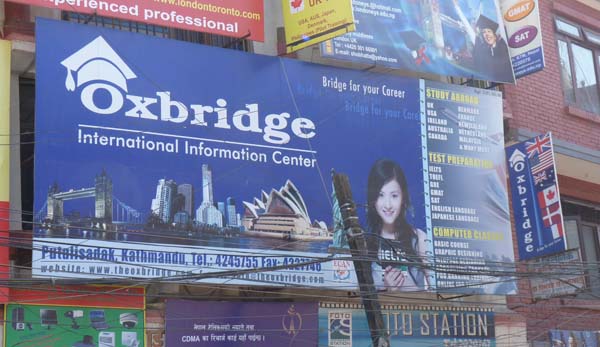
Redefining international level education.

Interesting expats.

Harvard@Putalisadak

What's extra??

Ookaay

LOL


What??


Wednesday, April 21, 2010

Greekomania

The advent of the republic in our little nation has begotten an interesting architectural trend here. Or is it the other way around? Goddamned chicken and egg! Anyways, today we see reinforced concrete houses adorned with fluted columns of the Corinthian order. We also see triangular pediments at the front end of an otherwise flat roof, and of course those beautiful dentils and renaissance windows. We finally caught up with you Mr. Plato.

Before we start going around in togas, one might point out that ancient Greece was a democratic entity consisting of several hundred independent poleis and that the Roman Republic was an oligarchic institution at the best of times. Is that what we are going for? But that is not my point. Let’s just stick to architecture.

The beautiful fluted columns originally began life in a tree trunk. Before stone architecture, columns were made of, well, tree trunks. And when you strip the bark off a tree trunk you are left with erratic little vertical fissures which is unpalatable to the human sense of pattern and order, ergo it was carved with regular vertical concave indentations. Obviously why still use them when stone rather than wood is used for the columns? Ritualisation? Not so soon. Stone columns didn’t come in one piece obviously. Hence many huge stones were stacked on top of another to make those mammoth columns. Those vertical indentations now served the purpose of making the horizontal clefts between the massive stones less visible. It probably also served the purpose of making the buildings look larger and the man looking at it smaller. Now the question is why do we still have fluted columns with fruity capitals when we have concrete? It’s a tough one. I think I will pass on that.
The pediments are an easy nut to crack. A gable roof will necessarily have a triangular front. Hence, we get the pediments. And some snob had an idea to make an inevitable feature look like an intelligent addition. Hence, we get those highly ornate pediments. Lord they are beautiful! So beautiful that even people with flat roofs can’t keep their hands off of them.

The dentils are even easier. When you make a house out of wood, you need rafters or long pieces of wood to hold the roof and the ceiling. And these rafters jut out of the main structure, for if they didn’t, they along with the roof and the ceiling would come tumbling down the rabbit-hole. Hence we have the real dentils of a wooden building, an inevitability and a necessity and the fake dentils of a stone building, an urge well to swing from the trees.

Besides the negativities, there is one little positive thing in this article. And that is the suggestion that we shift our architectural gaze to Egypt. Now I hope you asked "why?" this time as opposed to when you let them put up that Corinthian column at your home. Look if there ever was a stable man-made structure, it is the pyramid. It has 4500 years to testify to that. And it is not a question of if but when we’ll be hit by a 7 on the Richter scale.

Tuesday, April 20, 2010

Death Ritual

It is said that sorrow unites a family. However if looked at closely death in a family divides it into two distinct camps. It is not because of the common sorrow per se but rather because of reasonless rituals that follow a death.

Now all will have an urge to move on to the next article. Some will have made up their mind that this article is a rant of a westernized punk who doesn’t know ‘jackfruit’ about his own culture. For the second group it will be an endorsement of what they have felt and what they think every modern and rational person must feel. For the former, there is no point in reading something that they will never agree on while for the latter there is in point in reading something they already know. But patience is the key to surprise.

Now if you will care to pretend that we are at page zero of a new notepad, we might be able to start and end as friends, which is the way I insist it be.

The first thirteen days are an endless stream of rituals. This has to be done, this shouldn’t be done. This to eat, this to be avoided. Well you know the drill. Now let me ask the first group why all this ritual should be done? The most prevalent reason given is that it helps to secure heaven for the deceased. To this let me relate an anecdote from Mahavir’s life. The great Vipaswi, whose reputation spread far and wide, was approached one day by a humble man who had lost his father. This man asked Mahavir to do something so his dead father could attain Swargalok. The great sage hence asked the man to bring in a kilo of ghee and a kilo of small pebbles. The man most joyously brought these ingredients for the puja. Then Mahavir asked the man to put them in a nearby lake. The pebble of course sank to the bottom while the ghee floated to the top. The sage then asked the man to make the pebbles float and the ghee to sink. Perplexed, the man stammered, “But that my lord is impossible”. At this the great sage smiled and said, “If that is impossible, what makes you think that a little ritual will guarantee mokshya for your father? It is the nature of things that dictates its fate, makes the ghee to float and the pebbles to sink. Thus, it is nature of life that a man leads that decides his fate after death and not some ritual done after death.” However there is another reason given for the rituals, that of culture. Since it is our culture it must be followed unquestionably to the dot. But hold on isn’t child marriage, ‘Sati Pratha’ and polygamy our culture too? Some more back and forth exchanges will probably bring us to Lokaachar, “Everybody does it”. So we’ve gotten from appeal to authority to democracy. Such a shame. Before we go ad hominem let me clarify that I like democracy and all but I kind of like Mr. Galilei a lot more. If you will excuse that digression, it is time for the second group to answer some questions. What would you be doing during the thirteen days if there were no binding rituals? The answer I think is pretty simple. You would either be tugged down in the whirlpool of loss and stress or if you have a little more self restraint, you would be looking for things to keep yourself busy so you don’t keep thinking on and on about the loss. And that ladies and gentlemen is the meat; something that every psychiatrist tells the depressed, “Keep yourself busy”.

This reason for the ritual opens numerous doors of opportunity. To keep oneself busy, one might feed the poor rather than underfeed oneself or one might as well engage in charity rather than fill the pockets of priests. There are of course scores of ways to keep oneself busy and at the same time help oneself to make peace with the loss.

Another little ritual of ours is the use of rhino flesh in the ‘pinda’ that is made during the sharadda. One wise man told me that rhino flesh is used in satellite communication equipment too. The implication of course is that no matter where the dead person is the message will be passed on that the people he left behind still care for him and have hence sent food for him. I wasn’t too sure about the last part but it sure did explain why rhinos are so rare. Goddammed Rocket Boys!!!! I mean commmmoooon, seriously??? When puritans, the wise man I referred to earlier is a priest, use advancements in science, and that too not very gallantly to defend a culture that was grey before science was even a toddler, is when we know, “Houston, we’ve got a problem”. I suggest we replace the rhino flesh with horse or donkey flesh. They are after all the closest relative of the rhino.

Another of our ritual includes “Tarpan”, the before-meal food offering by sons to their deceased parents. Now if gratefulness still counts as a virtue, this is one great ritual. The ten seconds of thought diverted to the deceased parents to thank them or just to make peace with the loss channels grief very well.

There is no need to be conformists without a pause or rebels without a cause. All our rituals needs is a little mending.

Wednesday, March 31, 2010

Weird Signboards@Kathmandu Part 1


Peppers!!!!


No Wonder Kathmandu is full of traffic mishaps :D

Kudos to whoever came up with this one

I love this one.

Pretty cool huh??

Well.....